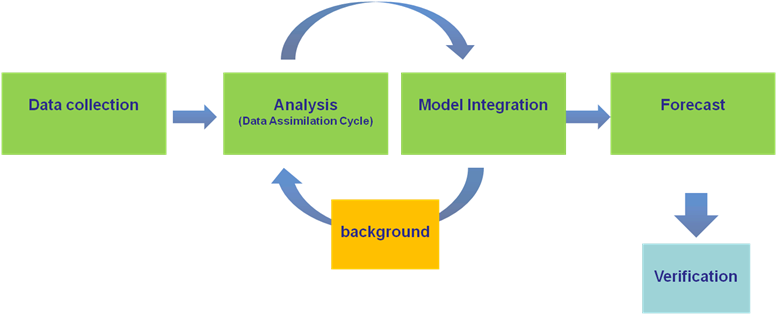
Numerical models represent the heart of what is known as Numerical Weather Prediction - NWP. In recent years, NWP models have reached a constantly growing level of reliability becoming widespread tools for the forecast activity of operational meteorological centers. The forecast atmospheric fields (pressure, temperature, wind, humidity, etc.) are obtained by the integration of a set of equations describing the atmospheric physical processes and how meteorological variables change with time. Numerical methods are used to find numerical approximations to the solutions of the prognostic equations of NWP models. Grid points models use a discrete representation of the atmospheric variables on a regular spatial grid. Numerical weather prediction is a very long and complex process, that includes four fundamental phases:
- data collection;
- analysis;
- forecast;
- verification.
Operational centers, such as the the National Centre for Aerospace Meteorology and Climatology (CNMCA), are able to provide information with a detail of few kilometers using NWP models of such complexity to require super calculators. The Italian Air Force Met. Service is provided with a "HP cluster linux" super calculator with performances of the order of 200 teraflops (floating point operations).
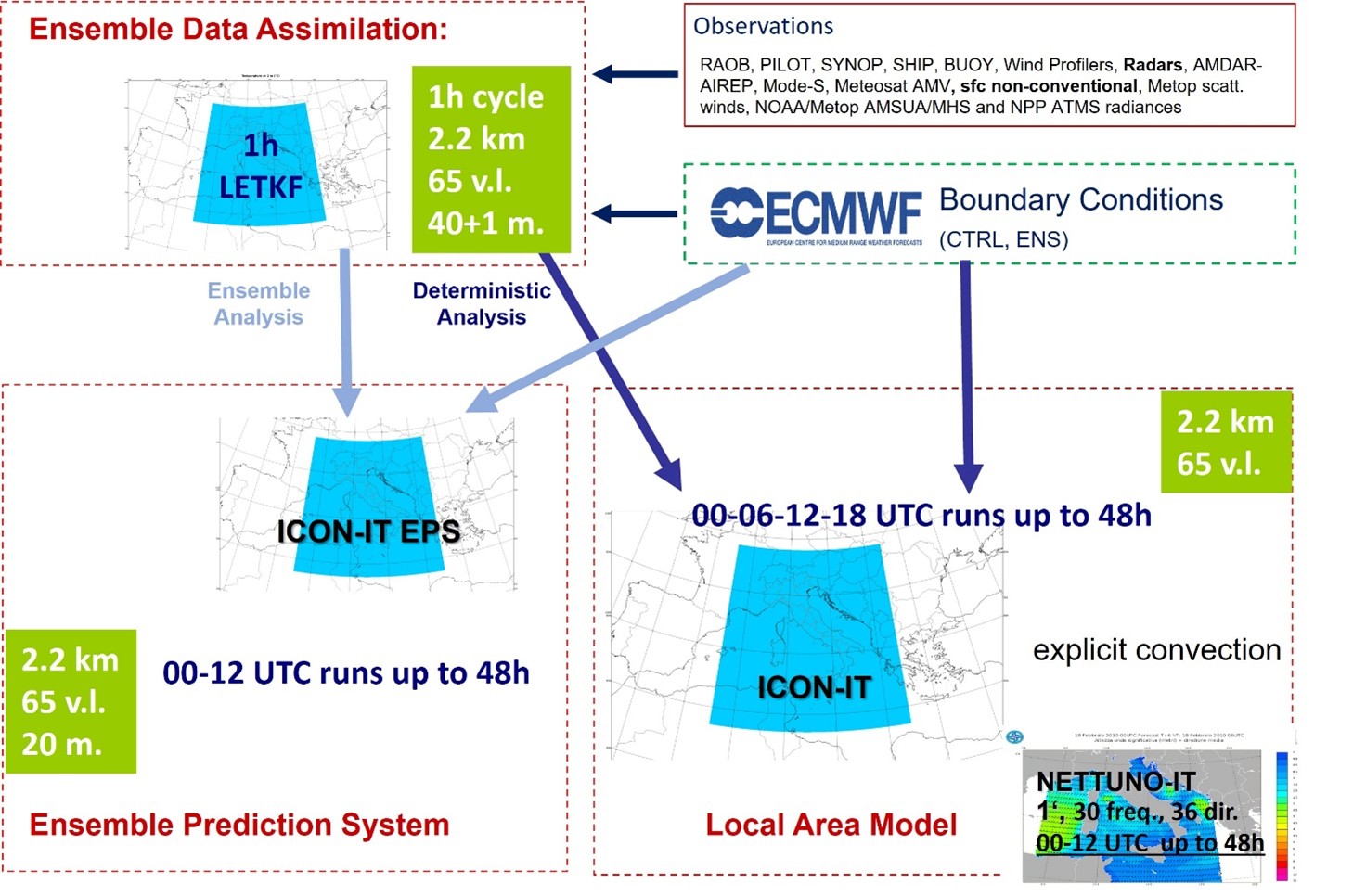
The operational short-range numerical forecasting system is composed of :
- Ensemble Kalman Filter (EnKF) Data Assimilation System based on the LETKF algorithm and the High-resolution non-hydrostatic model ICON integrated over the Italian region (2.2km, 30 vertical levels);
- Very high-resolution non-hydrostatic model ICON-IT integrated over the Italian region (2.2km, 65 vertical levels) both in deterministic and EPS configuration (20 members);
ICON-IT is driven by IFS-ECMWF boundary conditions and initialised by the high-resolution LETKF analysis.